|
Hornby Model Railway Locomotive Reviews -
N15 'Ling Arthur'
 Hornby
N15 'Ling Arthur'.
(R2580)
Rating 10/10 Hornby
N15 'Ling Arthur'.
(R2580)
Rating 10/10
Built to haul the heavy express trains to and from the ports served by the
LSWR, the Urie-designed N15 two-cylinder 4-6-0 locomotive was a development
of the smaller H15. The class eventually numbered 74 locomotives, built in
batches from 1918 to 1926, and they were much-modified throughout their
lives, with Urie’s original design being altered first by Maunsell and later
by Bulleid.

The Hornby model of the N15 first appeared in 2006 as part of the company’s
continuing rehabilitation of Southern Region modelling. It complements the
same company’s M7, West Country, Merchant Navy, T9 and, most recently,
Schools class locomotives. It is perhaps the very best of them all.
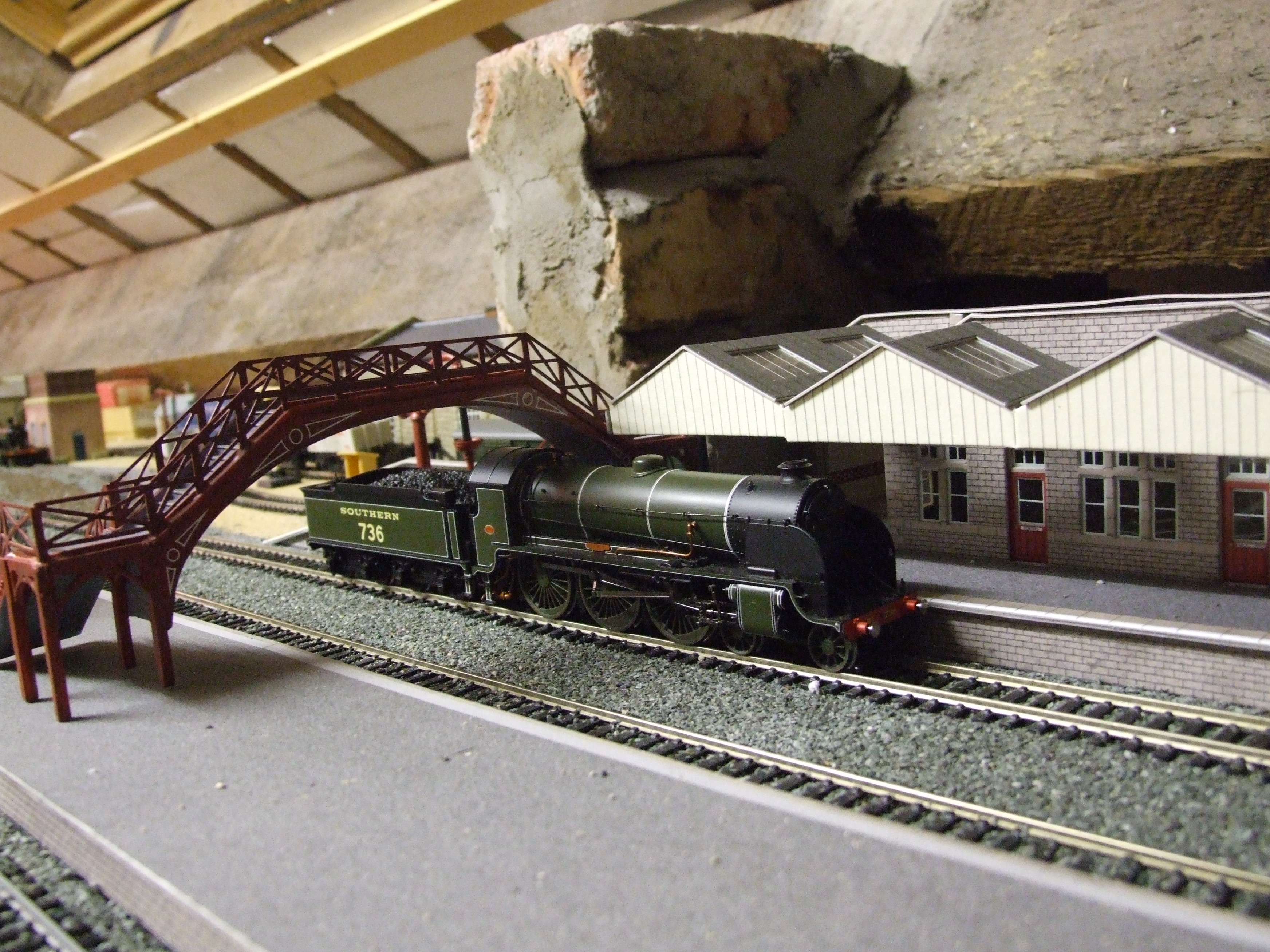
This model, 736 ‘Excalibur’ (R2580), represents the pathfinder for the
class, the first one built in August 1918 to Urie’s design. It features a
5,200-gallon tender of the Urie’s eight-wheeled bogie type. The locomotive
is DCC ready, with DCC-fitted versions available. It is locomotive-driven,
with electrical pick-up on all 18 wheels. This makes for superb control,
excellent slow-speed running, and smooth transitions even of ladders of
insulfrog points. The motor is Hornby’s current favoured 5-pole skew-wound
type, and it is both powerful and quiet. The model locomotive, like the
prototype, is equally comfortable on long rakes of wagons or long rakes of
coaches – it looks particularly good with Hornby’s new Pullmans or
olive-green Maunsells.

This model features slim tension-lock couplings in NEM pockets both on the
locomotive and on the tender, facilitating easy replacement with alternative
couplings should that be the modeller’s choice. It also come with a ‘goody
bag’ of detailing parts, including brake rigging and blast pipes, although
owners of train-set type layouts should be aware that adding the pipes
restricts the movement of the leading bogie, rendering it incapable of
traversing 2nd-radius curves (and giving it difficulty with 3rd-radius
curves too). Furthermore, the bogie is fixed to the frame with a bolt
through the centre of the bogie (unlike the older Hornby design whereby the
bogie was affixed to a swing arm), giving it relatively little vertical
play: this locomotive will not run onto Hornby’s turntable without
derailing, unless the turntable is sunk into the layout baseboard to reduce
the gradient transition.

The livery of this model is second to none – the olive green being
beautifully lustrous, and the lettering and lining crisply and perfectly
applied. The interior cab detail is, frankly, astonishing, and at the time
of its first release was probably the best of any 00 gauge model available.
(Arguably it still is, although my personal opinion is that the T9 and
Schools are fractionally better).
Other versions of this model are available, in BR green, with Maunsell-style
cabs, with six-wheel tenders, weathered, or any combination thereof. This
model is indispensable to anyone modelling the Southern Railway or Southern
Region BR, and frankly one need not look hard for an excuse to buy one. This
is probably the single finest 4-6-0 model available on the market today, and
probably the best model of any type available for less than £100.
Overall Rating: 10/10

[back to the top]
Diesel and Electric Review List








Steam Locomotive Review List


 
Thomas The Tank Engine And Friends


|