|
Hornby Model Railway Locomotive Reviews -
'Princess Royal' Class Pacific
 Hornby
'Princess Royal' Class Pacific.
(R2448)
Rating 7.5/10 Hornby
'Princess Royal' Class Pacific.
(R2448)
Rating 7.5/10
The 'Princess Royal' -class pacific's were designed by William Stanier and
constructed for the London, Midland and Scottish Railway between 1933 and
1935. They were designed to haul the fast express train 'Royal Scot' (the
rival service to the LNER's famous 'Flying Scotsman') from London Euston to
Glasgow Central. By November 1962 the last of them had been withdrawn from
service, although two have since been preserved.

Hornby's model captures the look of the prototype well. These were large,
graceful engines, and Hornby has accurately reproduced what was, for many,
the most elegant pacific to run on British metals.
The model is locomotive (as opposed to tender) driven, with electrical
pick-ups on all wheels, giving it a very large electrical footprint to
facilitate smooth slow-speed running. The motor is very responsive, but my
major criticism of the model lies with the motor's power output: the model
seems underpowered. It will stroll away with a twelve-coach train, if you
have the space to run such a thing, but it won't achieve a scale top speed
with it. The engine could do with being considerably heavier, and it could
use a more powerful motor.
Aesthetically, the model's various liveries all seem well-applied. The real
locomotives enjoyed many changes in colour and livery during their lives,
with LMS maroon, BR Blue and BR Green all appearing at one stage or another,
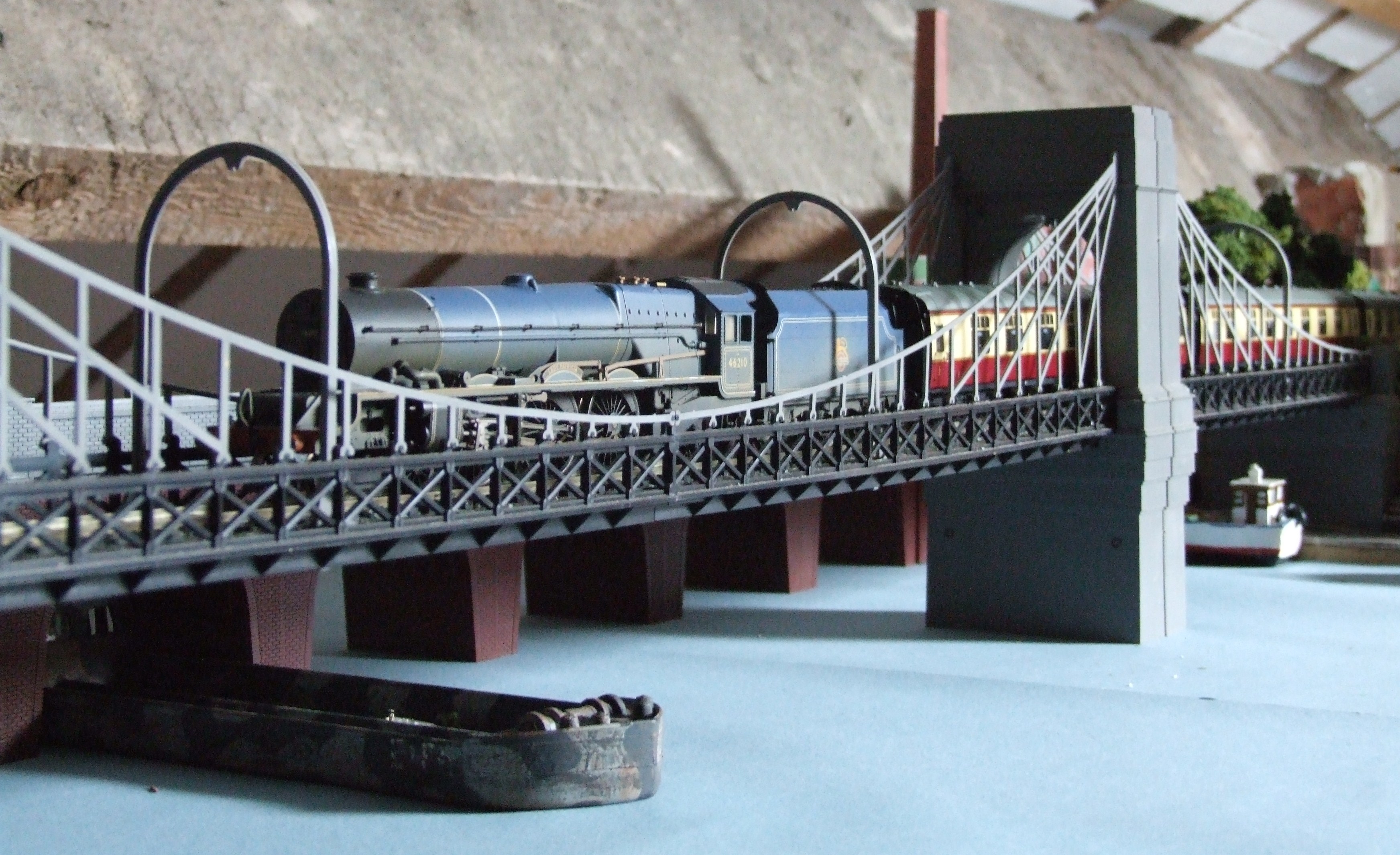
enhancing the appeal of the model. My example, the 2007 release of 'Lady
Patricia', is in BR Blue with factory-applied weathering, and you can see
for yourself how well it looks. It is particularly impressive when coupled
to Bachmann BR Mk1 coaches in crimson and cream.
I have one final reservation. Although the front coupling is a narrow
tension lock coupling in an NEM pocket (not fitted as supplied), due to the
redesign of the locomotive chassis to incorporate the motor (the Princess
Royal class has been part of Hornby's range since time immemorial, but until
2000 only as a tender-driven locomotive), the older tender design still has
a Lima-style large 'D-ring' tension lock coupler. This is not only unsightly
but may cause problems when running with NEM-coupled stock. Although mine
runs well with the Bachmann Mk1s, tackling 2nd radius curves at full speed,
derailing is a real danger with Hornby's Pullmans. This is because the
coupling on the Pullmans is mounted on a swivelling pivot, but the action of
the pivot is too stiff to cope with the broad D-ring on the Princess's
tender. Thus Pullman trains, at least on sharp radii, need to run more
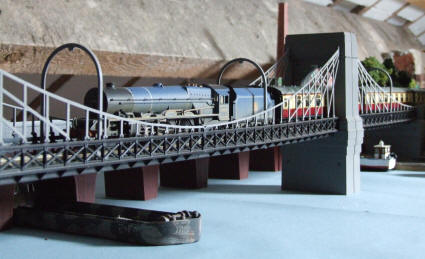
slowly. Having said that, you can see that on straight track at least a
commendably close coupling between locomotive and stock is achieved.

Overall this model is well worth buying. It looks excellent, is a huge
improvement over the older tender-driven versions, and is mechanically sound
(it will run for hours non-stop without problems). My reservations about it
only apply to those wishing to run scale-length expresses at speed, or fast
Pullmans round tight corners, but given that these are likely to affect a
minority of modellers they can be safely ignored by the majority.
Overall Rating: 7.5/10

[back to the top]
Diesel and Electric Review List








Steam Locomotive Review List


 
Thomas The Tank Engine And Friends


|