Model Railway Coupling
Author "Henry's grandad" (forum member)
Cheap DIY Model Railway Uncoupler
Uncoupling of Hornby rolling stock
Starting with a Thomas
Playmat layout, I quickly became aware of the damage that
a 5-year-old can do when trying to disconnect a loco from its
train, or indeed any uncoupling activity. The lifting and
twisting involved resulted in rolling stock being scattered in
all directions.
So a look at the Hornby
uncoupler track length caused some problems, first the cost,
second the size (which limits the positioning possibilities) and
third it seems to me to be particularly ugly!
Not having modelled for many
years, I searched the internet for alternatives, without
success. I did find an electrically operated device at
www.hmrg.co.uk/techtopics/tlock.htm , but this seems to be
an advanced modellers option, and quite expensive anyway.
So I thought back to my
modelling days in the 1970s and an idea which was current then.
I claim no responsibility for originating this idea and can’t
remember when or where it came from. Basically it consists of a
short bit of thin plastic strip being inserted in any section of
the track, although it works best on straight sections.
I only have an ancient test
track, about 2ft of Peco streamline (I think), since Henry’s
Thomas layout is 130 miles away, and I get there only about
every 8 weeks or so.
I cut a 10mm wide strip of
PET plastic 0.010”thick (0.25mm) about 85mm
long, and threaded it under the sleepers at each end, so that it
went under two sleepers and over 8 sleepers, in the centre of
the track, checking that it did not foul the backs of the
rolling stocks wheels. Depending on your make of track and its
sleeper spacing it may be necessary to adjust these details.

It formed a raised hump,
which was carefully adjusted for height by pushing items of
rolling stock over it to ensure that the coupling hooks lifted
clear of the bar. Pulling the stock over the ramp just depressed
it and does not lift them as they passed by. Once adjusted it
can be fixed simply by inserting a track pin at each end.
Below are some photos of
this test rig showing the strip in position, and with stock in
push and pull mode.

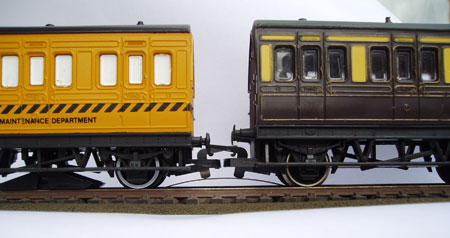
In operation the rake of
stock is pushed over the ramp and stopped with the couplings
disengaged, the loco then draws away leaving the rake behind.
To assist the spotting
exactly of the couplings, it may be necessary to have some sort
of marker alongside the track.
Oh, yes,
where did I get the PET plastic from? Mine came from the base of
a supermarket pack of small tomatoes! At
10 thousandths of an inch thick it had
just the right flexibility for the job. If you ignore the cost
of the tomatoes, the only cost is your time and a couple of
pence for the track pins.
[back to the top]
|